
Lost Volume After a BBL? What's Normal and How It's Corrected
Content
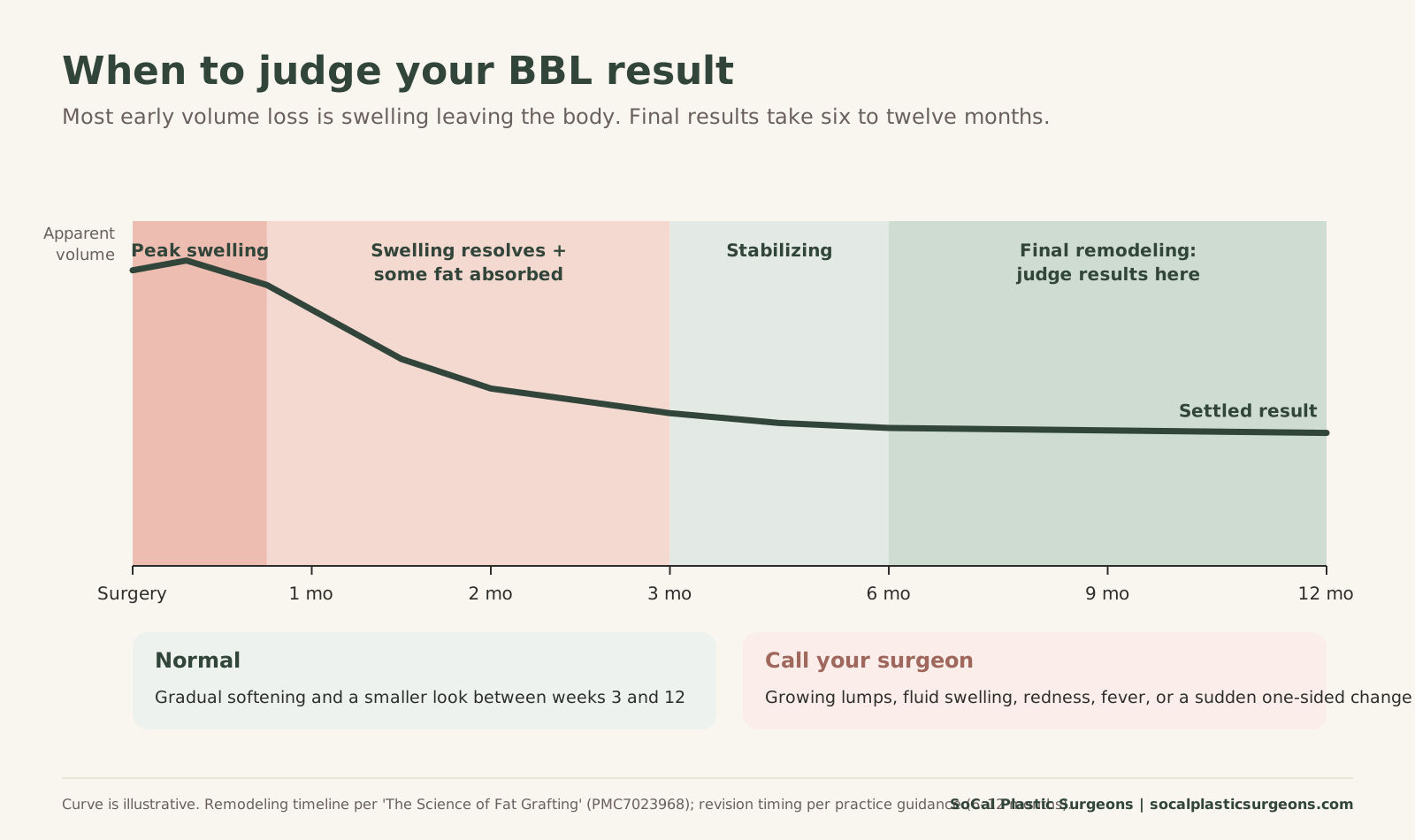
Almost every BBL patient has a moment, usually somewhere between week three and week ten, when she looks in the mirror and thinks, Where did it go? The dramatic fullness from the first days after surgery starts to fade, and it's easy to assume the fat is disappearing.
Sometimes it is, at least partly. But much of that early change is swelling leaving the body, which is exactly what's supposed to happen. The key is knowing which changes are part of normal healing, which ones deserve a call to your surgeon, and what can be done if your settled result truly ends up smaller or less even than you hoped.
Key takeaways
Early "volume loss" is mostly swelling resolving. Surgeons intentionally overfill slightly to account for it.
Some transferred fat doesn't survive. Published retention for buttock fat grafting commonly ranges from about 50% to 80%.
Fat grafts keep remodeling for months. Most surgeons want to wait six months to a year before judging the final result.
If a correction is needed, options include additional fat grafting, liposuction to rebalance, or, for patients who don't want a second surgery, AlloClae for localized refinement.
A realistic timeline: when to judge your BBL
Time after surgery | What's usually happening | What it means for you |
|---|---|---|
Weeks 1-3 | Peak swelling in both the buttocks and liposuction areas | Your buttocks look their biggest, but it isn't the final result |
Weeks 3-12 | Swelling resolves; some fat that didn't establish a blood supply is absorbed | This is when most patients notice "shrinking." It's expected. |
Months 3-6 | The surviving fat stabilizes; the waist and back continue to refine | Shape becomes more predictable |
Months 6-12 | Final remodeling | This is the right window to evaluate whether you need a touch-up |
Research on fat grafting supports this patience. A review of the science describes graft remodeling continuing for up to a year: an active regeneration phase through about three months, followed by stabilization for up to nine more months (The Science of Fat Grafting, PMC). That's why our BBL revision guidance recommends waiting at least six months to a year after the original surgery before considering further work.
Five reasons a BBL can look smaller than expected
1. The swelling was never permanent volume
In the first weeks, the buttocks are swollen from the fat transfer itself, and the waist and back are swollen from liposuction. As both settle, the buttocks get smaller, but the waist often gets smaller too, which preserves the curve. Surgeons also intentionally place more fat than they expect to keep. Our article on how long BBL results last explains why overcorrection of roughly 20-30% is common.
2. Some fat didn't survive
Transferred fat has to establish a new blood supply to survive, and not every cell does. How much survives depends on technique, the recipient area, and how well the area is protected during early healing. In one ultrasound-measured study of 50 patients who had fat placed only in the subcutaneous layer, about 81.8% of the injected volume remained at 12 months (Cansancao et al.). Broader averages tend to be lower, and some variation between patients is unavoidable.
3. Pressure during early healing
Fat that's compressed before it establishes a blood supply is more likely to flatten or fail. Dr. Nykiel puts it simply:
"If you're sitting on that fat or you're putting pressure on that fat, will that fat flatten out? The answer is yeah, probably it will. The more that you are off the fat, the better." Dr. Matthew J. Nykiel, What Is a BBL?
His instructions emphasize standing, kneeling, or lying on the stomach as much as possible for the first six weeks, and using a BBL pillow only when sitting can't be avoided. He also limits lower-body workouts and cardio during that period because heavy glute activity can reduce fat survival. Walking, however, is encouraged to reduce the risk of blood clots. For a week-by-week plan, see our BBL recovery timeline.
4. Weight loss after surgery
Fat that survives the transfer behaves like the rest of your fat: if you lose weight, it gets smaller. This is increasingly relevant for patients who start a GLP-1 medication after their BBL. If your weight has dropped since surgery, your result may have shrunk proportionally. We cover this in more depth in Ozempic Face and Body.
5. It's not less volume, it's less balance
Sometimes the total volume is fine, but one side healed differently, a hip dip reappeared as swelling faded, or the upper buttock lost definition. Dr. Nykiel describes four causes of uneven or lumpy contours after a BBL: loose skin, a localized fat bulge, tight collagen bands that dimple the skin, and insufficient gluteal muscle tone (Why Are Some BBLs Lumpy?). Each one has a different fix, which is why a correction should start with a proper diagnosis. If a returning hip dip is your main concern, see Hip Dips: What Causes Them.
When to call your surgeon instead of waiting
Gradual softening is normal. These are not, and deserve a prompt call to your surgical team:
A firm, tender, or growing lump
A soft, fluid-filled swelling (possible seroma)
Redness, warmth, drainage, or fever
A sudden, dramatic change on one side
Leg pain or swelling, or shortness of breath (seek emergency care)
For perspective, a recent review of ultrasound-guided buttock fat grafting pooled 6,235 patients and reported minor complications at about 6.3 per 100 patients, including seroma at about 2.9 per 100 and fat necrosis at about 0.1 per 100 (Aesthetic Surgery Journal). Most issues are manageable when they're caught early.
How lost or uneven volume is corrected
What happened | Typical correction |
|---|---|
Overall volume is lower than hoped after 6-12 months | Additional fat grafting, if enough donor fat remains |
One side is larger or a localized bulge formed | Liposuction of the fuller area to rebalance |
Hip dips or upper-buttock definition faded | Targeted fat grafting, or AlloClae if you'd rather avoid surgery |
Dimpling from tight bands | Releasing the bands, often with small-volume grafting |
Loose skin creating ripples | A skin-tightening procedure or a buttock lift, depending on location |
Shape is fine, but tone is lacking | Guided glute strengthening once cleared, often alongside other options |
Additional fat grafting
If your settled result is smaller than planned and you still have harvestable fat, a second round of grafting is the most direct way to add volume. Our BBL revision procedures combine liposuction, fat grafting, and, when needed, skin tightening. The limitation is donor fat: many patients use most of their available fat the first time. Our how long BBL results last article notes that about 6-10% of patients request additional grafting, typically after six to twelve months.
Liposuction to rebalance
When the problem is asymmetry or an area that stayed too full, removing fat can restore balance. Dr. Nykiel regularly performs BBL reductions for patients whose results look too large or wide. That procedure takes about an hour under sedation and usually involves only a few days to a week off work.
AlloClae for localized refinement, without a second surgery
For patients who don't want to go back to the operating room, or who don't have enough donor fat left, AlloClae can be a reasonable way to refine specific areas. It's a structural adipose filler made from purified donor fat and placed under the skin in the office, usually with local anesthesia. Our practice uses it for post-surgical and post-liposuction contour irregularities, hip dips, and localized volume loss.
AlloClae isn't a substitute for a full BBL, and if you're planning surgery anyway, you likely won't need it. But for smoothing a residual hip dip or restoring a little upper-buttock definition, it avoids liposuction, general anesthesia, and another round of sitting restrictions. Dr. Nykiel usually starts with modest amounts, around 25 cc per area, and builds gradually every six weeks to three months (AlloClae Explained). Results commonly last one to three years.
Why a second round is different from the first
If you're considering more surgery, it helps to know how a revision differs from your original BBL:
Donor fat is more limited. The easiest areas to harvest were probably used the first time. Your surgeon may need to go to new areas, such as the upper back, arms, or inner thighs, or accept a more modest volume goal. Our guide to how much fat you need for a BBL explains how that budget is estimated.
Scar tissue changes the work. Previously treated areas can be firmer and less even, which makes both harvesting and placing fat more technically demanding.
The goal is usually refinement, not a redo. Most revisions focus on specific zones, such as a hip dip that reappeared or an upper buttock that lost definition, rather than adding volume everywhere.
Safety standards don't change. Fat still belongs only in the subcutaneous layer, above the muscle, with ultrasound guidance.
What your surgeon will look at
During a revision consultation, expect Nykiel will review your original goals and any operative notes, compare photos from before surgery and each stage of recovery, check your weight history since surgery, assess the remaining donor fat and skin quality, and examine the buttocks for asymmetry, dimpling, or firm areas. From there, he can tell you whether the best path is patience, a targeted surgical correction, or a non-surgical refinement.
Protecting the volume you have
If you're still early in recovery, these habits give your graft the best chance:
Stay off the buttocks as instructed, especially during the first six weeks.
Wear your compression garment. Dr. Nykiel typically keeps BBL patients in a garment for the first three months to help swelling resolve and skin settle.
Keep up with lymphatic massage. In his protocol, it starts the day after surgery; most patients do about 15 sessions over six weeks.
Hold your weight steady, and talk to your surgeon before starting weight-loss medication.
Avoid nicotine, which impairs blood flow to healing tissue.
Frequently asked questions
Is it normal for my BBL to shrink at two months?
Yes. Between roughly week three and month three, swelling resolves and some fat is absorbed. Most of the shape you see at three to six months is much closer to the final result.
When is a BBL result final?
Most surgeons evaluate the final result between six and twelve months, once the graft has stabilized.
Can I gain weight to bring my BBL back?
Surviving fat can grow with weight gain, but so will fat everywhere else, including your waist. It's rarely a good strategy. A targeted correction is usually a better option.
Can AlloClae fix a flat BBL?
It can refine specific areas, such as the hip dips or the upper buttock, without surgery. For a large overall volume deficit, additional fat grafting is usually more effective if you have the donor fat.
I had my BBL somewhere else. Can Dr. Nykiel evaluate it?
Yes. Many revision patients had their original surgery with another surgeon. Bring your operative notes if you have them, along with photos from before surgery and from each stage of recovery.
Get an honest assessment
If you're past the six-month mark and unhappy with your volume or shape, or if you're earlier in recovery and want reassurance, an evaluation will tell you what's normal healing and what's worth correcting. Schedule a consultation with Dr. Nykiel in Newport Beach or Upland, or request a virtual consultation to get started. You can also explore our BBL revision options and financing.
Sources
The Science of Fat Grafting. PMC review.
Cansancao AL, et al. Subcutaneous Only Brazilian Butt Lift. PRS Global Open abstract supplement. 2018.
Ultrasound-Guided Gluteal Fat Grafting: What Is the Evidence? Aesthetic Surgery Journal. 2026;46(1):57.
ASPS, PSF, The Aesthetic Society, ASERF. Gluteal Fat Grafting: A Joint Safety Statement. 2022.
Nykiel MJ. What Is a BBL?, Why Are Some BBLs Lumpy?, BBL Reduction, and AlloClae Explained. SoCal Plastic Surgeons YouTube channel.