
How Much Fat Do You Need for a BBL? The Donor-Fat Math, Explained
Content
You're slim. Maybe you run, lift or just never gained much. And you've started to wonder if a Brazilian butt lift is even possible for a body like yours.
It's one of the most common questions we hear. There's no single number on the scale that decides it. What decides it is a budget: how much fat we can gently take from your body, how much of it will survive, and where we spend it.
Dr. Matthew J. Nykiel, a board-certified plastic surgeon in Newport Beach and Upland, plans every BBL around shape first. Once you see how that budget works, it gets much easier to tell which path fits you: a traditional BBL, a Skinny BBL, AlloClae or, for a few patients, implants.
Key takeaways
There's no minimum weight or BMI for a BBL. What matters is how much pinchable fat you have and where it sits.
Only part of the fat survives the move, so the plan builds that in. Many studies land between about 50% and 80%.
Your fat gets shared among the hip dips, upper buttock and center of the buttock. For lean patients, the win is usually shape, not size.
If you don't have enough fat, or don't want surgery, AlloClae adds volume with purified donor fat and no liposuction.
Why is there no minimum weight for a BBL?
Patients often look for a cutoff. A BMI, a weight, a jean size.
The trouble is that two people with the same BMI can carry very different amounts of usable fat. One has a soft layer across her flanks, lower back and inner thighs. The other is muscular and has very little fat under the skin anywhere. Same number. Very different plan.
That's why the exam matters more than the scale. Most of our Skinny BBL patients have a BMI between 18.5 and 24.9. But the real decision comes from Dr. Nykiel's hands: where you can be pinched, how thick that layer is, and how much can come out while your waist, back and thighs still look smooth.
A few things shrink the budget:
A naturally lean or athletic build
Big recent weight loss, including weight loss on GLP-1 medicines
Past liposuction in the usual donor areas
Fat that sits deep around the organs (visceral fat) instead of under the skin. Liposuction can't reach it.
How does the donor-fat math work?
Step 1: Start with the shape you want
We don't start with a number of cc's. We start with a picture. Some patients want a big change in projection. Many who come to us want something softer: fuller hip dips, a clean curve from the lower back into the buttock, and a rounder shape in jeans.
As Dr. Nykiel puts it, "I think if you look at the before and afters, I'm typically more on the natural side."
That's good news if you're lean. A natural goal needs less fat than an extreme one.
Step 2: Plan for the fat that won't survive
Moved fat has to grow a new blood supply. Not every cell makes it.
Across all body areas, a review in the plastic surgery literature reports that the share of grafted fat the body reabsorbs ranges from 20% to 90% (The Science of Fat Grafting). Careful technique narrows that range a lot. In one study of 50 patients who had fat placed only above the buttock muscle, ultrasound showed about 81.8% of the volume still there at 12 months (Cansancao et al., PRS Global Open). Wider averages tend to sit around 50% to 70%. We cover what that means over the years in How Long Do BBL Results Last?
So you place more than you plan to keep. Here's a simple example. It's for illustration, not a prediction for you.
To keep about... | If this much survives... | Plan to place about... |
|---|---|---|
300 cc per side | 70% | 430 cc per side |
300 cc per side | 60% | 500 cc per side |
For context, a safety study of fat-based buttock lifts reported an average of about 422 mL placed per side, with a range of 210 to 850 mL (Kalaaji et al., Aesthetic Surgery Journal).
Step 3: Account for what gets filtered out
What comes out during liposuction isn't pure fat. It's mixed with the numbing fluid we use to protect the tissue, plus a little blood and oil. We clean and filter it before it goes back in. That means the amount removed is always bigger than the amount placed. For a lean patient, that difference can feel large.
Step 4: Split the budget among the zones
A BBL isn't one injection in the middle of the buttock. It happens in two parts.
First comes liposuction of the torso, often called lipo 360, usually from the armpit down. That alone starts to build the hourglass, because a slimmer waist and lower back make the buttock look fuller before any fat is added.
Then the fat goes into three zones, in this order of importance for most lean patients:
The hip dips. Dr. Nykiel thinks of this as the frame of the buttock. Our guide to what causes hip dips explains why the hip line shapes the whole silhouette.
The upper buttock. Fat here creates that visible shelf between the lower back and the buttock.
The center of the buttock. This is where projection comes from.
When the budget is tight, zones one and two usually matter most. A smooth hip line and a defined upper buttock change how you look in clothes far more than a small bump in projection. To see how each donor area affects shape, read Where Does BBL Fat Come From?
If you're not sure where your own fat sits, that's exactly what a consultation sorts out. Dr. Nykiel can usually tell you in one visit which zones your budget can cover.
Which option fits your amount of donor fat?
After the exam, most plans fall into one of four paths.
Your situation | Usual recommendation | What to expect |
|---|---|---|
Moderate to generous pinchable fat; wants clear curves | Liposuction plus fat transfer; the most volume and shape change | |
Lean, but has pinchable fat in several spots; wants balance | Fat taken from several areas and placed where it shows most | |
Very little fat, or no interest in surgery | In-office injections of purified donor fat; no liposuction | |
Very lean and wants more projection than fat can give | A silicone implant placed in surgery; see Butt Implants vs. BBL |
What makes a Skinny BBL different?
A Skinny BBL follows the same rules as a traditional BBL. The budget is just smaller, so every cc has a job.
We often collect fat from several places at once: the belly, flanks, back, inner or outer thighs, and sometimes the arms. Then we place it where it changes your outline the most. The goal is proportion. A lean runner with flat hip dips can look very different with a few hundred cc's in the right spots.
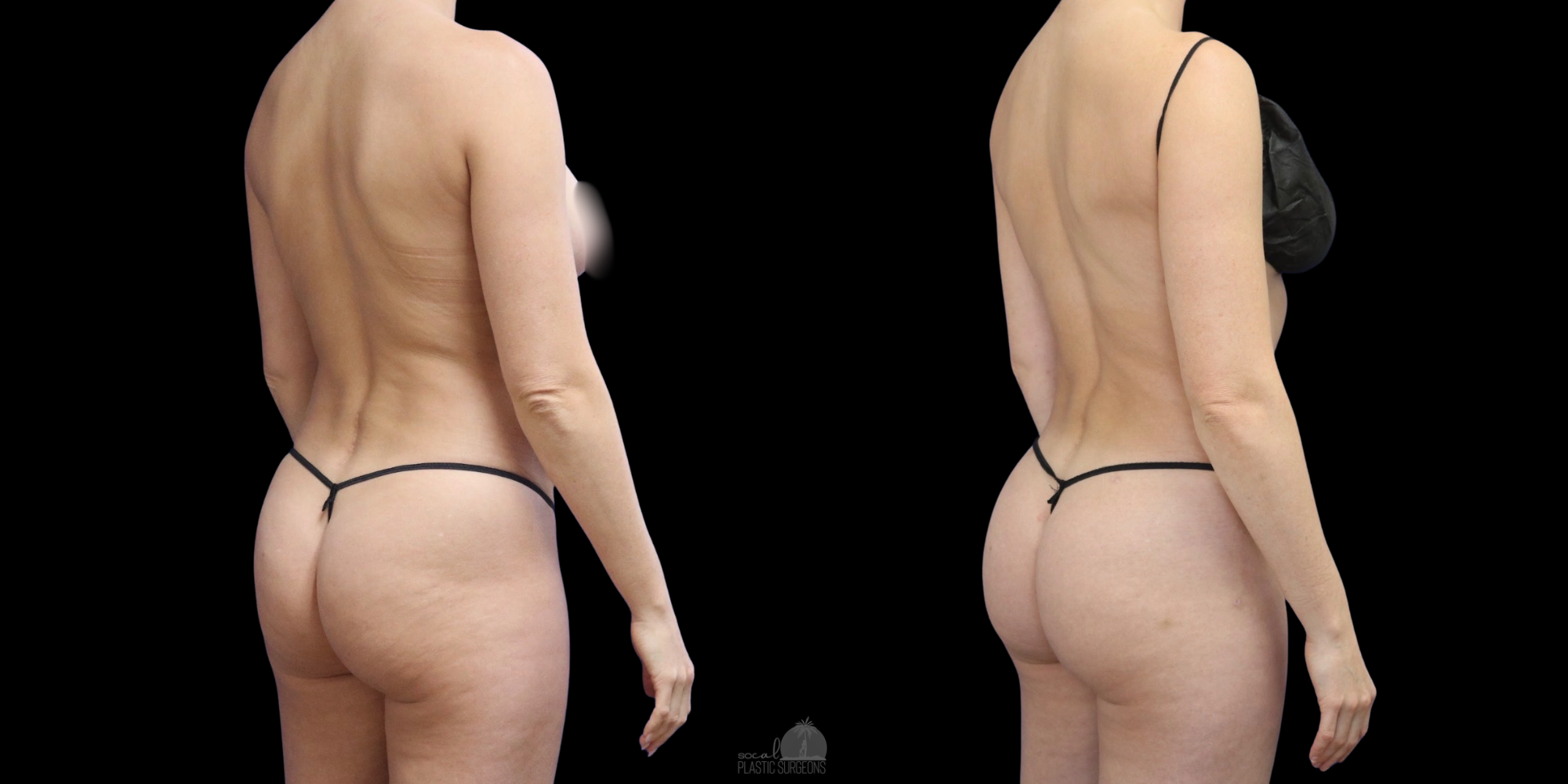 Skinny BBL by Dr. Nykiel. Individual results vary.
When does AlloClae make more sense than surgery?
Some patients simply don't have the fat. Others don't want surgery or BBL recovery at all. For them, AlloClae opens a door that didn't exist a few years ago.
AlloClae is made from donated human fat that has been cleaned and processed. The manufacturer describes it as intact fat cells that are no longer living, plus the natural support tissue around them. It's regulated as a human tissue product under Section 361 of the Public Health Service Act (Tiger Aesthetics application instructions). It's meant for placement under the skin in areas where fat normally lives (AlloClae Safety Information).
Here's how Dr. Nykiel uses it:
Start low, build slowly. He usually begins with at least 25 cc per side in each area and adds more every six weeks to three months. That keeps the shape easy to control and spreads out the cost.
Same zones, different focus. He treats the upper buttock, the hip dips and the center of the buttock. He rarely adds volume to the bottom of the buttock, because it can make the shape look square.
A little goes further. AlloClae is firmer than moved fat. As he puts it, "The change that 25 cc's of AlloClae gives me would take about 100 cc's of fat." That's his clinical experience, and results vary from patient to patient.
Treatment takes 30 to 60 minutes with local numbing. Most patients get back to normal life in one to two days, and many keep the added volume for one to three years. Dr. Nykiel explains how it works in this short AlloClae video.
If you have enough fat for a BBL, you usually won't need AlloClae. Think of it as a separate path for patients who can't or don't want to go the surgical route. For a side-by-side look, read AlloClae vs. Fat Transfer. For other injectable choices, see Non-Surgical BBL.
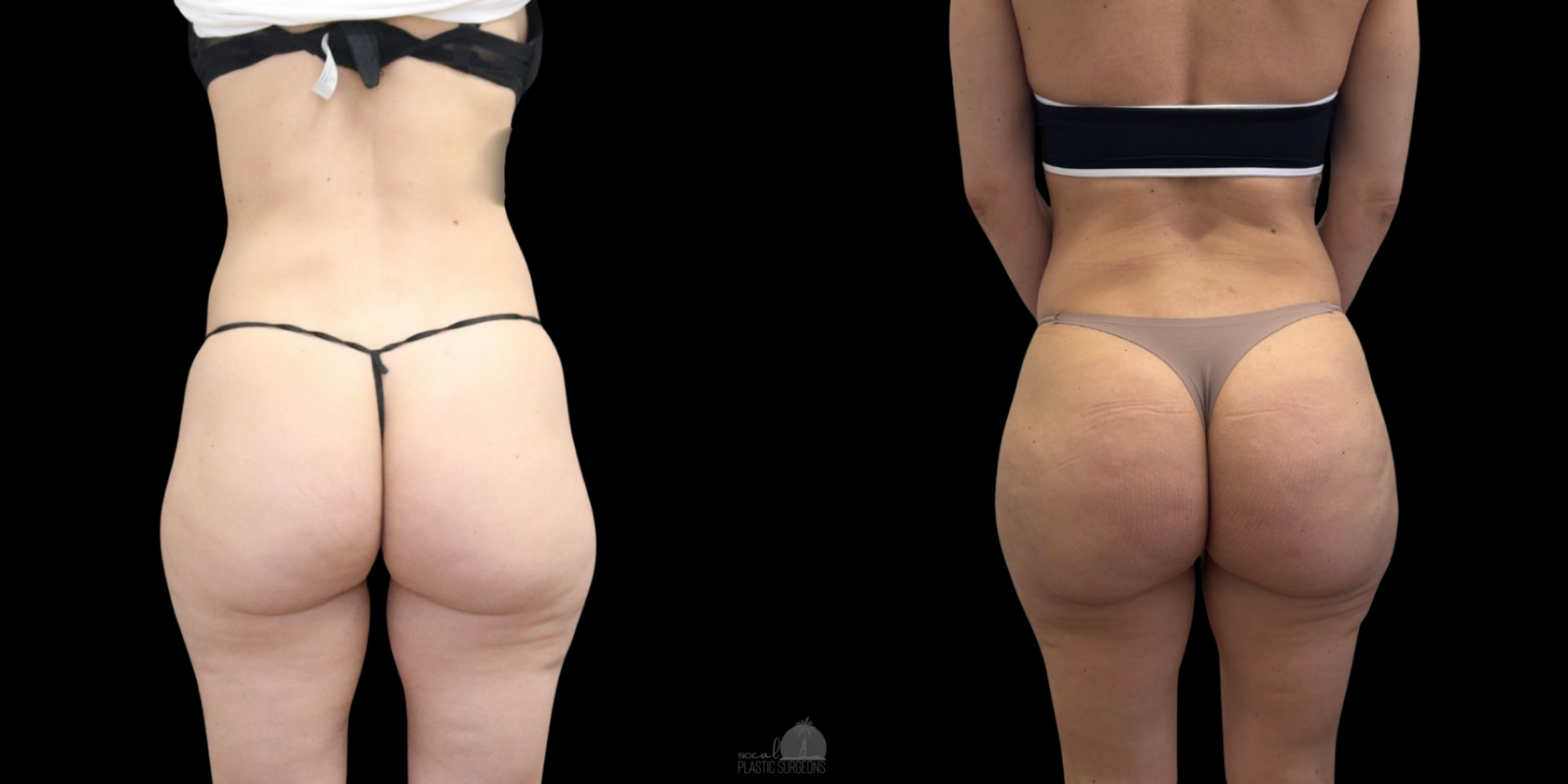 AlloClae by Dr. Nykiel. Individual results vary.
Why does the right amount matter more than the most?
With a small budget, it can be tempting to push for every last cc. That's not where great results come from.
The American Society of Plastic Surgeons and The Aesthetic Society have issued joint safety guidance for fat grafting to the buttocks. It calls for placing fat only in the layer under the skin, above the buttock muscle, and supports live ultrasound during injection (ASPS and The Aesthetic Society Joint Safety Statement). The safety study above also favors moderate volumes and keeping fat out of the muscle (Kalaaji et al.).
Dr. Nykiel uses ultrasound to confirm the fat stays above the muscle. We go deeper into this in BBL Safety: What Patients Need to Know.
A smart plan for a lean body spends the budget well. Balanced hips and a defined upper buttock look more natural than one overfilled spot.
What happens at your consultation?
The fastest way to stop guessing is an exam. Here's what to expect when you meet with Dr. Nykiel:
A talk about shape, not just size. Bring photos you like. Be specific: hip dips, the upper shelf, projection or overall balance.
A check of your donor areas. He'll feel for pinchable fat across your belly, flanks, back and thighs, and look at your skin.
A look at your weight history. If you're still losing weight, including on a GLP-1 medicine, it's usually best to reach a steady weight first. Moved fat acts like the rest of your fat. If you lose weight later, it shrinks too.
A clear answer. You'll leave knowing whether a BBL, Skinny BBL, AlloClae or implants fits your body, and why.
Live outside Orange County or San Bernardino County? You can start with a virtual consultation and send photos ahead of time.
Frequently asked questions
Can I be too skinny for a BBL?
You can be too lean for a traditional BBL. That doesn't mean you're out of options. A Skinny BBL uses a smaller amount of fat in the spots that matter most, and AlloClae adds volume without using your own fat at all.
Should I gain weight before a BBL?
Talk with your surgeon before trying this on your own. Moved fat grows and shrinks with your weight, so if you gain for surgery and lose it later, your result shrinks too. Any plan should be built around a weight you can comfortably keep.
How many cc's of fat does a BBL use?
It depends on your body and your goal. One study reported an average of about 422 mL per side, with a range of 210 to 850 mL (Kalaaji et al.). Dr. Nykiel will give you a realistic range after your exam.
Can I have a second round if I want more volume?
Sometimes, once the first result has settled, usually six to twelve months later. Many lean patients use most of their donor fat the first time, though. AlloClae can be a nonsurgical way to refine one area later. See Lost Volume After Your BBL? for how touch-ups are planned.
How long does AlloClae last?
Many patients keep the added volume for one to three years, and more sessions can maintain or build on it. It's a newer product, so long-term data is still growing.
Find out what your body can support
You don't have to guess. Schedule a consultation with Dr. Nykiel and leave knowing how much donor fat you have and which path gets you closest to the shape you want.
Newport Beach: 1401 Avocado Ave, Suite 501A, Newport Beach, CA 92660
Upland: 490 N Mountain Ave, Suite A, Upland, CA 91786
Phone: (949) 416-0038
Traveling in? Request a virtual consultation and send photos ahead of time.
Browse our BBL, Skinny BBL and AlloClae results, and see our financing options to plan ahead.
Sources
American Society of Plastic Surgeons, The Plastic Surgery Foundation, The Aesthetic Society, ASERF. Gluteal Fat Grafting: A Joint Safety Statement. 2022.
Kalaaji A, et al. Gluteal Augmentation With Fat: Retrospective Safety Study and Literature Review. Aesthetic Surgery Journal. 2019;39(3):292.
Cansancao AL, et al. Subcutaneous Only Brazilian Butt Lift: Do We Need to Choose Between Safety and Optimal Outcomes? PRS Global Open abstract supplement. 2018.
The Science of Fat Grafting. PubMed Central review.
Tiger Aesthetics. alloClae Allograft Tissue Information and Application Instructions.
This article is for educational purposes and isn't a substitute for an individual medical evaluation. Individual results vary.