
Tummy Tuck After C-Section: Your Scar, Shelf & Muscle Repair
Content
About one in three babies in the United States is delivered by cesarean. The rate was 32.4% in 2024, according to the CDC's National Center for Health Statistics (Births: Final Data for 2024). Many of those mothers eventually notice the same thing: a small overhang of skin and fat sitting just above the scar that doesn't seem to change, no matter how much they diet or train.
That overhang, often called a C-section shelf or pouch, is one of the most common reasons moms come to see us about a tummy tuck. This guide explains why it forms, what a tummy tuck does to it and to your old scar, how your anatomy determines whether you need a mini or full procedure, and how to time surgery around your family plans.
Key takeaways
The C-section shelf is caused by scar tissue tethering the skin inward, combined with stretched skin, fat, and often separated abdominal muscles. That's why exercise doesn't fix it.
In most full tummy tucks, the skin that contains a low C-section scar is removed, and the new scar is placed low enough to hide under most underwear.
A mini tummy tuck only works when the problem is limited to the area below the belly button. Muscle separation after pregnancy usually calls for a full tummy tuck.
Most surgeons recommend waiting at least six months after delivery, longer if you're breastfeeding, and ideally until you're finished having children.
Why the C-section shelf forms
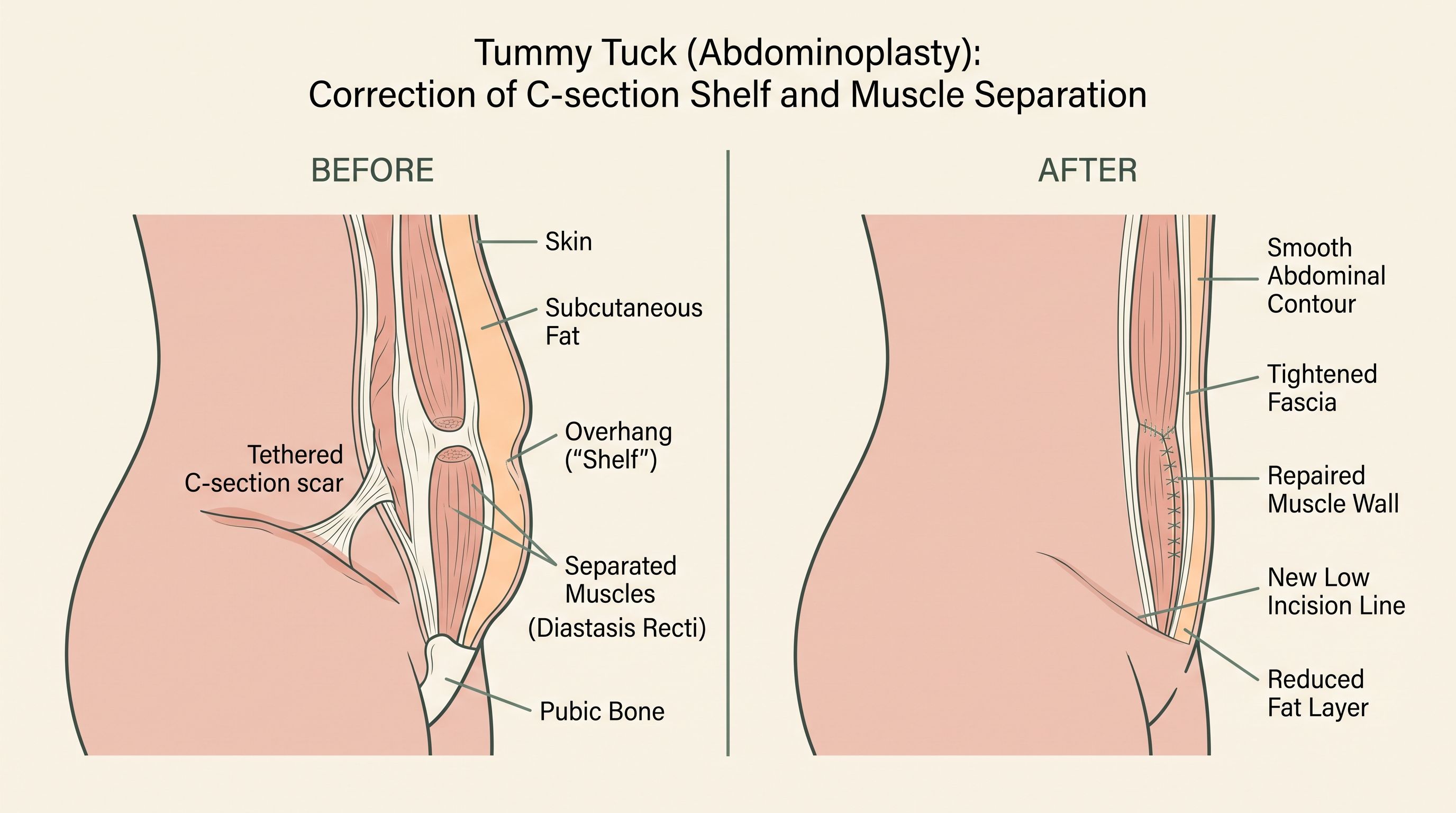
A C-section passes through several layers: skin, fat, the fibrous sheath over the abdominal muscles, and the lining of the abdomen. As those layers heal, scar tissue can bind the skin at the incision line to the deeper tissues underneath. The skin and fat directly above that anchored line have nowhere to go, so they fold over it. That's the shelf.
Several things usually add to it:
Stretched skin from pregnancy that has lost some of its ability to snap back
Fat in the lower abdomen, which is often the last place to slim down
Separated abdominal muscles (diastasis recti). In one prospective study of 300 first-time mothers, 60% had measurable separation at six weeks postpartum and about a third still had it at 12 months (Sperstad et al., British Journal of Sports Medicine)
Multiple C-sections, which can create more scar tissue at the same site
Because the tethering is structural, weight loss can make the shelf smaller but rarely eliminates it. Crunches can't release scar tissue or remove stretched skin.
What a tummy tuck actually changes
Dr. Nykiel describes the goals of a tummy tuck as three-fold:
"Remove that excess, loose, hanging skin... Tighten those tummy muscles back up... [and] the belly button can sort of create a sad shape or a non-normal-looking appearance," so it's reconstructed into a more natural shape. Dr. Matthew J. Nykiel, What Is a Tummy Tuck? Goals, Recovery & What to Expect (lightly edited for readability)
For a C-section patient, that means the tethered scar is released, the overhanging tissue is removed, the separated muscles are brought back together, and the skin is re-draped smoothly.
He's also candid that the goal has changed over the years, from a very tight, flat abdomen to something that looks like it belongs on your body:
"Originally, very similar to facelifts, we made an extremely tight-looking tummy... It created a sort of tight shape that really never looked like it went along with the body."
His approach today pairs the tummy tuck with liposuction to create softer, natural contours along the midline and the edges of the abdominal muscles. "A tummy tuck itself helps to tighten skin very nicely, but it doesn't create those shapes and curves that we look for," he explains. "Liposuction does."
What happens to your C-section scar?
This is usually the first question C-section patients ask, and the answer is generally good news.
A full tummy tuck removes the skin and fat between roughly the belly button and a low incision near the pubic area. If your C-section was a standard low horizontal incision, it typically sits within the skin that's removed, so the old scar is taken out along with the shelf. You'll have a new scar, and it will be longer than your C-section scar, typically running from hip to hip. But it's placed low enough to sit under most underwear and swimsuit bottoms, and the tethering that caused the shelf is gone.
A few situations change the plan:
A higher-than-usual C-section scar may not fall entirely within the removed skin. Your surgeon will show you where your new scar will sit relative to the old one.
A vertical (up-and-down) C-section scar requires a different conversation, because it can affect how the tissue above it is moved.
A thick or raised scar can be revised during the tummy tuck, but your own healing tendencies still matter. Ask about scar care after surgery.
Mini, full, or extended tummy tuck after a C-section
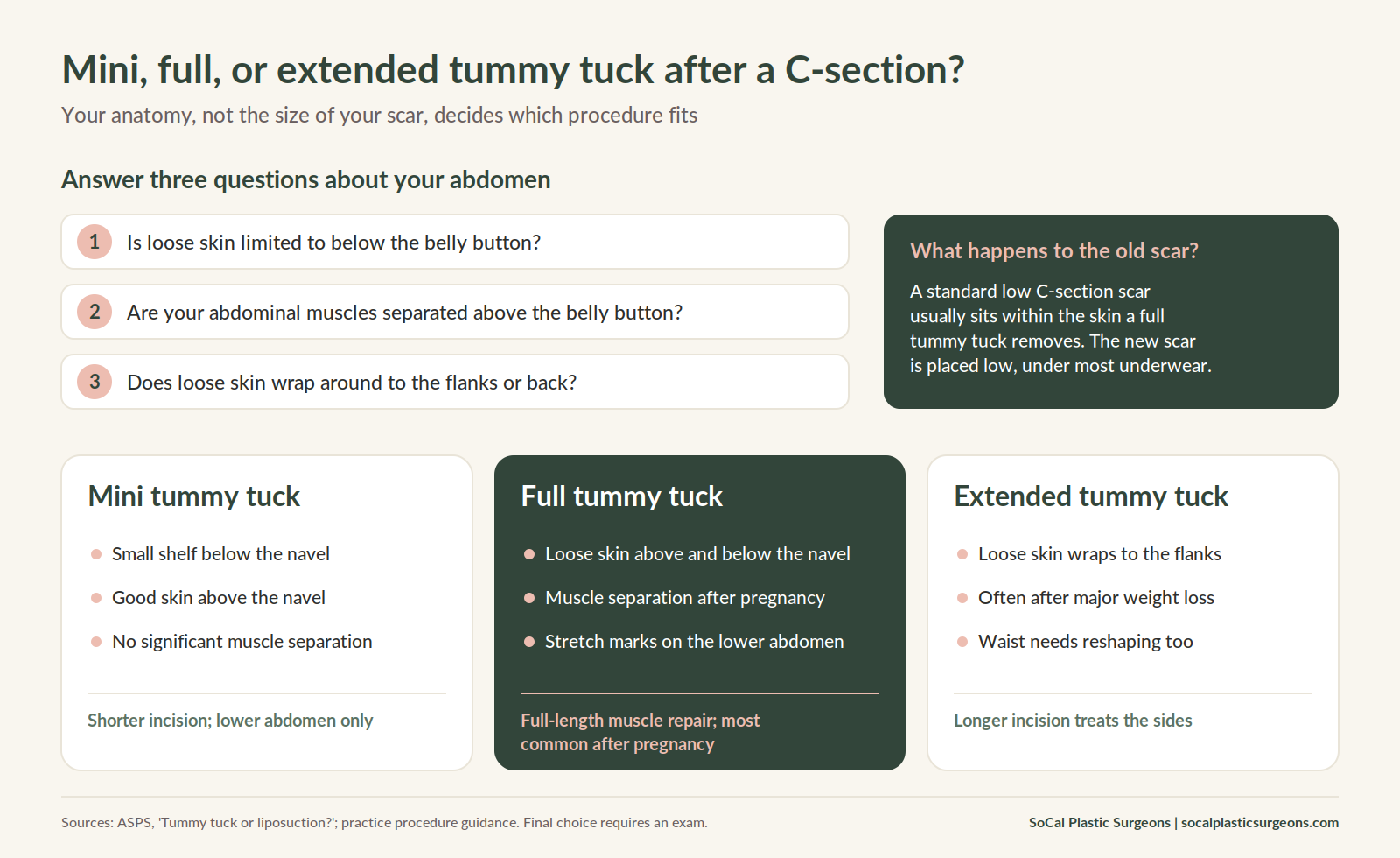
Your anatomy | Most likely procedure | Why |
|---|---|---|
Small shelf limited to below the belly button, good skin above it, no significant muscle separation | Mini tummy tuck | Shorter incision; addresses only the lower abdomen |
Loose skin above and below the belly button, muscle separation, stretch marks | Full tummy tuck | The only way to repair the full length of the separated muscles and re-drape all of the skin |
Loose skin that wraps around the flanks, often after weight loss | Extended tummy tuck | A longer incision addresses the sides as well as the front |
The key point is muscle separation. After pregnancy, diastasis typically runs along the midline above and below the belly button. The American Society of Plastic Surgeons notes that complete muscle repair is possible only through a standard (full) tummy tuck (ASPS: Tummy tuck or liposuction?). A mini tummy tuck may sound appealing because the scar is shorter, but if your muscles are separated above the belly button, it can leave you with a bulge that the procedure can't fix.
Not sure whether you need skin removal at all? Our guide on liposuction vs. tummy tuck walks through the skin-quality test surgeons use.
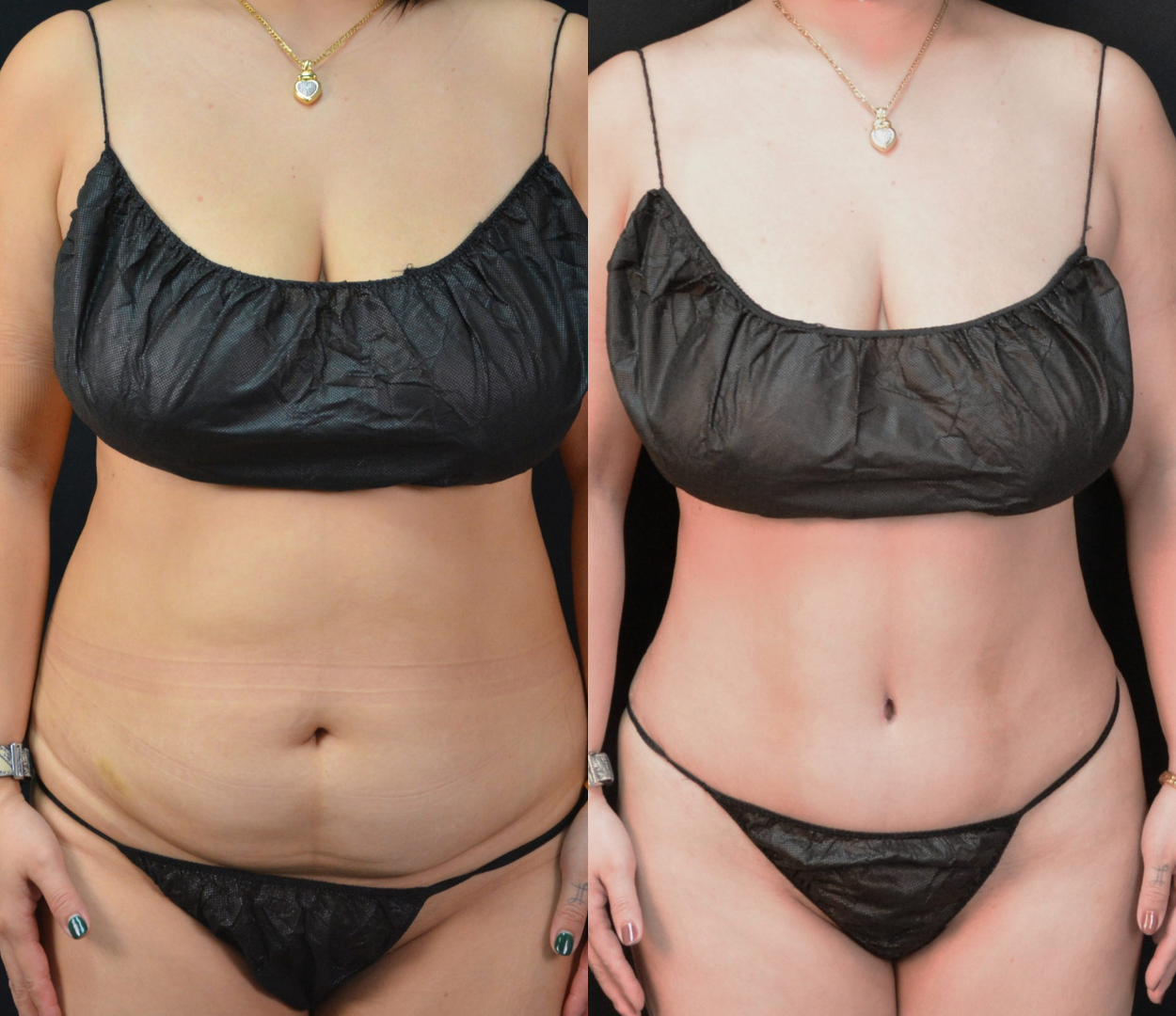
After multiple C-sections
Each additional C-section tends to leave more scar tissue in the same area. That doesn't usually prevent a tummy tuck, but it can make the dissection a bit more involved and may affect how the lower abdomen looks before surgery.
Your surgeon will also check for a hernia, which is a weakness in the abdominal wall that lets tissue bulge through. After a C-section, hernias that need repair are uncommon. A Danish study of more than 57,000 women found about two hernia repairs per 1,000 cesarean deliveries over ten years, most often with vertical incisions (Aabakke et al., PLoS One). If you have a bulge that gets bigger when you cough or strain, mention it at your consultation.
When to schedule a tummy tuck after a C-section
Timing matters as much as technique. General guidance from the American Society of Plastic Surgeons is to wait at least six months after delivery before surgery like a tummy tuck, and longer if you're breastfeeding, because the body can keep changing for up to a year after pregnancy (ASPS: Post-pregnancy plastic surgery).
You're likely in a good position when:
You're finished having children, since another pregnancy can stretch the muscles and skin again
Your weight has been stable for several months and you're near your goal
You're fully recovered from delivery and cleared by your OB
You're nicotine-free. Our practice requires stopping nicotine at least four weeks before and after surgery
You have help at home, especially for lifting young children
Many moms choose to combine a tummy tuck with breast surgery as a mommy makeover. Whether that should happen in one surgery or two depends on your health and the total operating time. We explain how that decision is made in One Surgery or Two? How Mommy Makeover Procedures Are Combined or Staged.
Recovery: what to expect (and how it compares to your C-section)
In Dr. Nykiel's practice, a tummy tuck takes roughly three hours under general anesthesia and is done as outpatient surgery. You go home the same day as long as a responsible adult can stay with you for the first 72 hours, and private nurses or recovery homes are available if not. Most patients take about two weeks off work.
Many C-section moms are surprised by which part of recovery feels most familiar:
"The tummy muscle repair, if you've ever had a C-section, is what most people feel the most of." Dr. Matthew J. Nykiel, What Is a Tummy Tuck?
To help, he places a long-acting numbing medication along the muscle repair that lasts about two to five days, which makes it easier to get up and moving sooner. Other parts of his protocol include:
Wireless leg compression devices for the first two weeks, because blood clots (DVT) are the most significant risk after a tummy tuck. Walking early also helps.
A fitted compression garment, sometimes with foam pieces, to help the skin heal into the intended contours.
A gradual return to activity. Walking starts right away; most regular activities resume around six weeks.
The hardest part for most moms is not lifting their children. Plan for help with carrying toddlers, car seats, and laundry baskets for the first several weeks. For a detailed timeline, see Tummy Tuck Recovery Timeline: What to Expect Week by Week.
Frequently asked questions
Will a tummy tuck remove my C-section scar?
In most full tummy tucks, yes. A standard low C-section scar usually sits within the skin that's removed. You'll have a new, longer scar placed low on the abdomen.
Can I get a tummy tuck at the same time as my C-section?
Most plastic surgeons advise against it. Your body needs to recover from pregnancy and delivery, and your weight, skin, and muscles continue to change for months. Waiting also lets your surgeon plan around your final anatomy.
Is a mini tummy tuck enough to fix a C-section pouch?
Only if the problem is limited to the area below the belly button and your muscles aren't significantly separated above it. Many post-pregnancy patients need a full tummy tuck to get a flat, stable result.
Can I have more children after a tummy tuck?
It's possible, but another pregnancy can stretch the repaired muscles and skin and undo part of the result. Most surgeons recommend waiting until you're done.
Does insurance cover a tummy tuck after a C-section?
A cosmetic tummy tuck generally isn't covered by insurance. We offer financing options, and our tummy tuck cost guide explains what affects the price.
Talk through your options
Every C-section shelf is a little different: where your scar sits, how much skin is involved, and whether your muscles are separated all shape the plan. Schedule a consultation with Dr. Nykiel in Newport Beach or Upland to find out whether a mini, full, or extended tummy tuck fits your anatomy, and exactly where your new scar will sit. Virtual consultations are available if you're traveling for surgery. You can also view our tummy tuck before-and-after gallery or read our complete guide to tummy tuck surgery.
Sources
Osterman MJK, et al. Births: Final Data for 2024. National Vital Statistics Reports. CDC/NCHS.
Sperstad JB, et al. Diastasis recti abdominis during pregnancy and 12 months after childbirth. British Journal of Sports Medicine. 2016.
Aabakke AJM, et al. Incidence of Incisional Hernia after Cesarean Delivery: A Register-Based Cohort Study. PLoS One. 2014.
American Society of Plastic Surgeons. Tummy tuck or liposuction?
American Society of Plastic Surgeons. Post-pregnancy plastic surgery: What can you do now, and what needs to wait. 2026.
American Society of Plastic Surgeons. Tummy Tuck Candidates.
Nykiel MJ. What Is a Tummy Tuck? Goals, Recovery & What to Expect. SoCal Plastic Surgeons YouTube channel.